| History and Postal Markings | Mixed Frankings |
| Postal Rates | Stamps Used |
| 2008 Update & Addendum | References |
The Greek postal presence in Egypt began with the establishment of a Greek Consulate in Alexandria in November 1833. This is the earliest date of any foreign postal service in Egypt (the French, the next to be opened, began in 1837). This event followed a protracted struggle ended by the Treaty of Adrianople (4 Sept. 1829), by which the Ottoman Empire conceded the independence of Greece. It thereby accorded Greece the privilege of opening consulates in Ottoman territory. Such consulates were entitled to operate postal agencies. Further historical details are given by Dacos1, by Boulad d'Humieres2, and by Byam3.
Consular agencies were opened where there were appreciable Greek populations such as Constantinople, Smyrna, and Alexandria. Unlike the other nations that operated post offices in the Ottoman Empire (in later years), Greece did not have a national shipping line. Instead, it arranged with the lines of other countries for a Greek postal courier to carry the Greek mails on their ships.
On August 29th 1833 an arrangement was concluded with a banker of Piraeus named Feraldi for a courier on his sailing ships which connected Alexandria with Athens (Piraeus) and other important ports via the island of Syra (Syra was a major shipping nexus in the nineteenth century). This arrangement was extended to the French packet service in May, 1838; the service was three times a month and took four days.
Note: In the following discourse, it is necessary to keep in mind the fact that Greece used the Julian ('old style') calendar, which was twelve days earlier than the Gregorian calendar used by western Europe and Egypt. For consistency with dates found on covers, the dates quoted here will be Julian, insofar as the available information sources are unambiguous.
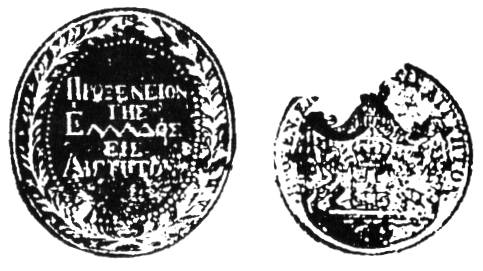
It is not certain when the Greek postal agency was actually opened to the public. The earliest known letters (31 March 1834) are Consular mail, franked by an impression of the seal of the Consulate. They are addressed to Nauplion which was the first capital of the newly independent country. Specific authority for use of the Consular seal to confer official franchise was given in the instructions to the first Consul2, but no truly postal handstamps were provided. Boulad records but four examples of this consular franking which used two different seals (Fig. 1).
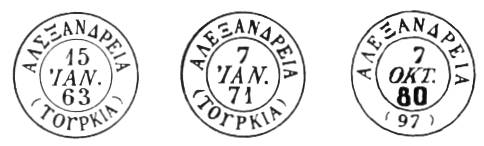
The consulate in Alexandria was reopened in 1857, and in 1858 the post office was physically separated from it and given its own premises on the Rue de la Poste. It was in this year that the first postal circular date-stamp was introduced, Type D-1, inscribed AΔΣΞANΔPEIA / TOYPKIA (Fig. 2).
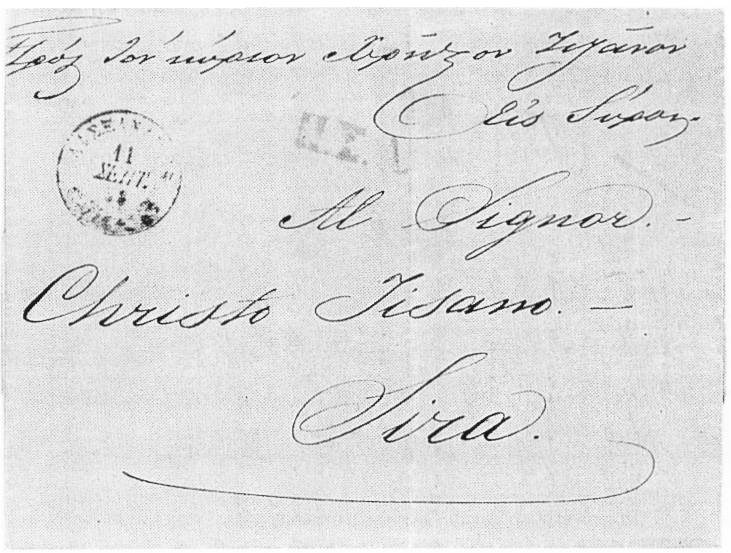
Boulad gave October 24th 1858 as the earliest date he knew of, but I now have an example dated September 11th (Fig. 3). Although type D-1 was replaced in 1869, it was resurrected and used again as late as 1878.
Type D-1 is obviously misspelled, having Σ where E is required. Finally, in 1869, a new date-stamp, D-2, with the correct spelling was introduced. The earliest date recorded by Boulad is November 22nd 1869. Although black is the usual color, blue and grey-blue are also known.
Type D-2 was eventually replaced in 1872, but the latest recorded date is October 25th 1876. It thus continued in use sporadically, alongside its successor, Type D-3, the earliest date recorded for which is May 22nd 1872. The word TOYPKIA of Types D-1 and D-2 was replaced by the assigned number, 97, in Type D-3. This Type was used without further change until the final closing of the Greek post office on the last day of 1881.
When stamps were supplied to the Alexandria post office in 1861, a special obliterator was provided for them, a diamond of dots with the number 97 in the center (Fig. 4). It was generally struck in black, exceptionally in blue. The earliest use of Greek stamps at Alexandria is 30 SE 61, one day before their use was officially authorized. The date-stamp D-1 continued in use for information purposes, and was struck on the cover separately (Fig. 5).
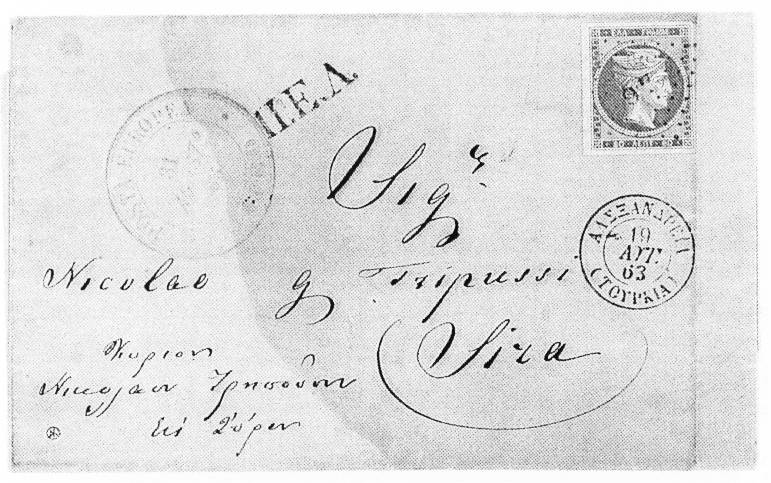
Fully prepaid letters were commonly marked with a three-letter handstamp, Π.E.Δ or Δ.E.Π, struck in black, blue, or red (Fig. 6). It stands for ΔIKAIΩMA EΞOTEPIKON ΠΛHΩΘEN meaning 'foreign postage paid'. It is thus the equivalent of P.D. applied to such letters sent through other postal services.

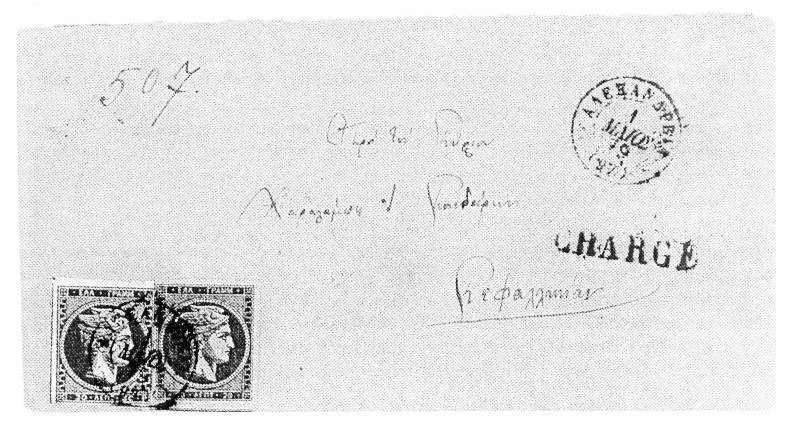
Registered letters are rare from the Greek office in Alexandria and no example has been reported from the pre-UPU period. Two registered handstamps are known: R-1, reading CHARGÉ in Latin letters (in effect from 1874) and R-2, reading SYSTHMENON in a rectangular box (Fig. 7).

With the eventual arrival of date-stamp D-3, which contained the post office number, came an order to discontinue use of the obliterator and to use the new date-stamp in its place for cancelling stamps.
On the earliest letters, including perhaps all pre-stamp letters, rate markings appear not to have been used. Boulad and Mattheos have stated that the rate was 30 lepta per 7½g in 1844 for letters carried on French packets, 60 lepta (12 kreuzer) in 1845 by Austrian packet, and 40 lepta by Italian packet.
With the introduction of stamps, rates became identifiable. The earliest stamped letters were franked with 80 lepta, a rate that remained in force until 1866. The existence of letters charged 110 lepta, however, is somewhat enigmatic. It is not unreasonable to suppose that the Greek port-to-port rate of 30 lepta may have been applicable for the Syros-Athens leg (80 + 30 = 110 lepta).
Official letters and documents were charged 5 lepta. A decree of October 23rd 1866 set the rate at 40 lepta per 15g for letters carried on Austrian steamers and 80 lepta for double-weight letters. At the same time, the postage for samples was set at 15 lepta per 15g and for periodicals, 6 lepta per 30g.
Until January 1st 1869 it was optional whether or not to prepay postage. On that date, prepayment became obligatory for internal letters and unpaid letters were to be charged double on arrival. Letters to and from the consular offices were exempted from this requirement.
The General Postal Union (soon to become the UPU), to which Greece was a founding adherent, came into force on July 1st 1875 (Gregorian) at which time uniform rates for international mail were established. For the Greek postal service the new rate was 30 lepta per 15g.
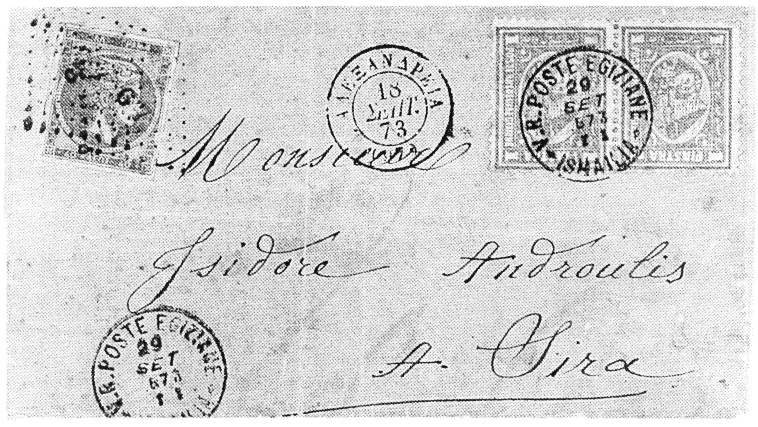
Although the Greek post office accepted letters at Alexandria franked with Greek stamps only, letters from elsewhere in Egypt required other franking to get them to Alexandria. Before 1866 such franking was without stamps; the handstamps of the Posta Europea (or the pre-stamp Government Post from April 1865). From January 1st 1866 (Gregorian), stamps of the First Issue of Egypt and later, the Second and Third Issues (Fig. 10), were used to frank letters as far as Alexandria.
Mixed franking of Egyptian stamps with Greek stamps thus became possible. Examples are quite rare (much more so than mixed frankings of Egyptian stamps with Austrian, British, French, or Italian stamps). In assessing such covers, it should not be forgotten that Egypt used the Gregorian calendar; the Greek date-stamps thus read earlier than the Egyptian, even though they were applied later.
The classic stamps of Greece, the large Hermes heads, comprise a complex group, with many printings differentiated by only subtle distinctions. Greek stamps are known used at Alexandria as early as September 30th 1861, a day before the official issue date. It appears that all of the printings were supplied to Alexandria (with perhaps the odd exception). All values, from 1 to 80 lepta, are known with Alexandria (or '97') cancellations.
When postage due stamps were issued by Greece in 1875, they were put into use in Alexandria (Fig. 11). I have seen every denomination of the first issue with Alexandria '97' cancellations, except the 1, 60, and 80 lepta values. They can be considered rare and covers are extremely rare. Although postage due stamps were usually cancelled with the '97' grid obliterator, the date-stamp was occasionally used.
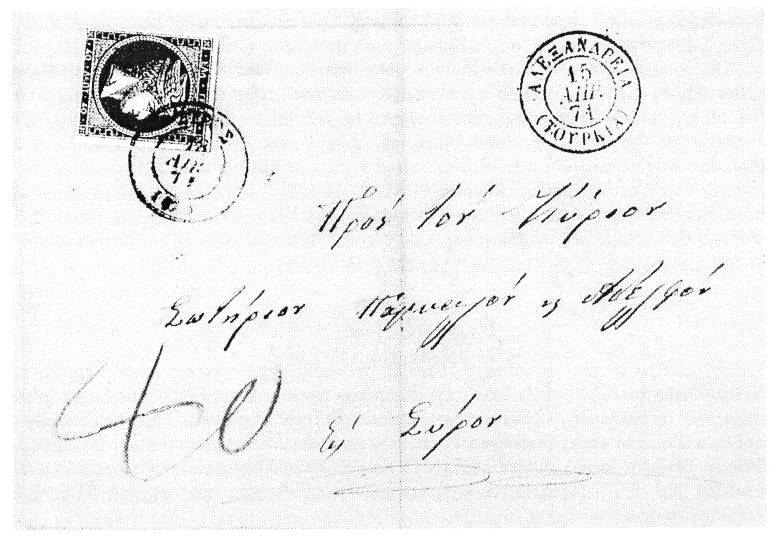
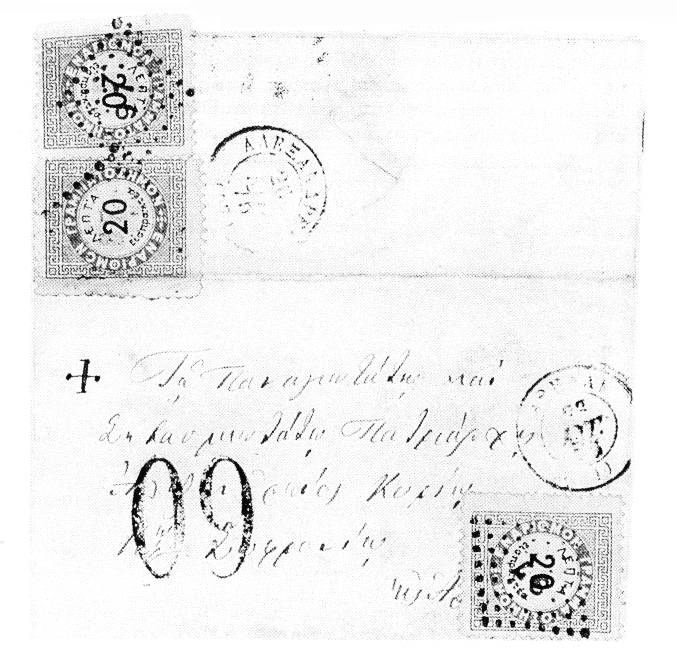
From "Egypt: Stamps & Postal History update July 2008"
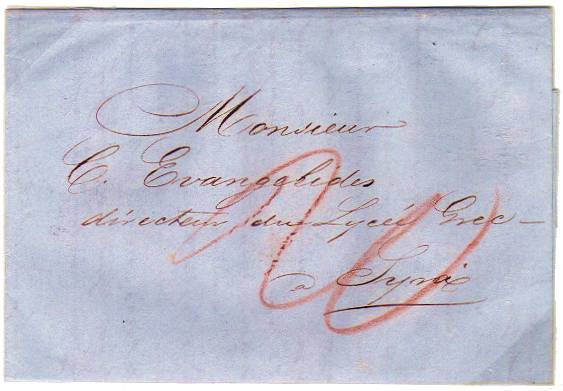
Marked "20" in red crayon for 20 lepta due. There was no date-stamp provided to Alexandria prior to 1858. The message was written in Greek. Backstamped on arrival at Syros Mαρτ 1853 (Julian date).
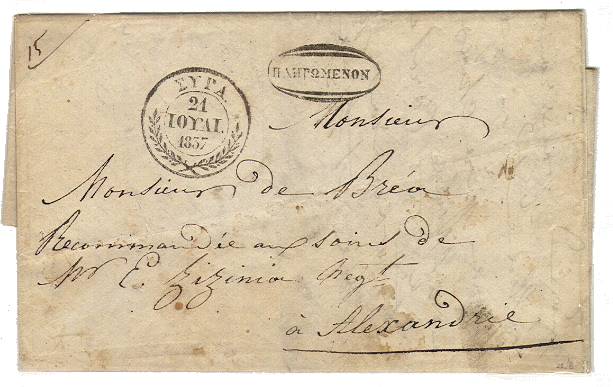
Letter from Syra to Alexandria, 21 July 1837 (Julian date) struck with date-stamp of Syra plus ΠΛHPΩMENON (paid).
No postal date-stamp is known for the Greek post office at Alexandria between the date of opening (November 1833) and 1858. This cover may be the earliest known example of civilian mail between Greece and Alexandria (consular letters are known from 1834).